

What Makes a City Thrive?
Lessons From Cities That Designed Their Success

In some cities, a housing project moves from proposal to construction in months. In Chicago, similar projects can take years, even when demand is clear and financing is in place. In some places, a transit upgrade is planned and delivered on a predictable timeline, while in others it moves forward unevenly, pausing and restarting along the way.
The outcomes people associate with thriving cities, including growth, affordability, reliable services, and vibrant public life are produced by systems that determine how decisions are made and how quickly those decisions are carried out.
In many cities, these decisions are formalized in a charter, a governing document that defines authority, accountability, and process. A municipal charter functions as a local constitution, setting the terms for how power is distributed and how decisions move through the system. The Civic Federation describes it as the framework that determines how authority is structured and how accountability is maintained.
Cities that perform well over time tend to make these structural choices explicit, defining the system clearly and maintaining it in ways that produce consistent outcomes.
Clarity of authority: New York City
New York’s charter establishes a strong mayoral system with clearly defined executive authority, alongside independent oversight through elected offices such as the comptroller. The charter outlines agency structure, budgeting authority, and oversight mechanisms in detail, creating a system in which decision-making power is both concentrated and monitored.

This structure supports large-scale coordination. New York’s ten-year capital strategy exceeds $100 billion and is managed across agencies with defined roles and responsibilities. Oversight is continuous, with the comptroller auditing contracts and publishing reports that track spending and performance.
These structural features support a complex economy by allowing infrastructure, housing, and service systems to be managed across millions of residents with a high degree of coordination.
In contrast, Chicago has 50 alderpersons, each with significant influence over zoning and development decisions within their ward, a practice often referred to as aldermanic prerogative. This distribution of authority means that similar projects can move at different speeds depending on where they are located and how decisions are made at the ward level.
Where New York concentrates authority and layers oversight mechanisms on top of that structure, Chicago distributes authority geographically, which introduces variability into how consistently decisions are applied across the city.
Professional execution: Phoenix
Phoenix operates under a charter-based council-manager system in which elected officials establish policy direction while a professional city manager oversees operations. This model is designed to separate political decision-making from administrative execution.
The International City/County Management Association explains that the council-manager system places responsibility for day-to-day operations in the hands of trained professionals, creating a more consistent approach to management across departments.
Phoenix added more than 160,000 residents between 2010 and 2020, according to the U.S. Census Bureau, making it one of the fastest-growing large cities in the country. Growth at that pace requires systems that can deliver services, approve development, and coordinate infrastructure with a high degree of consistency.
The structure supports that consistency by centralizing administrative processes under professional management, which reduces variation in how policies are implemented across departments and over time.
Chicago executes differently, department leadership is appointed and can change with mayoral administrations, while operational authority is distributed across multiple agencies that must coordinate with one another to implement policy. Chicago’s capital improvement program is developed across departments with differing timelines and priorities rather than through a single unified administrative structure.
This structure means that execution depends more heavily on alignment between departments and leadership at a given point in time, which can lead to variation in how consistently projects are delivered.
Local control: San Francisco
San Francisco operates as a charter city under the California Constitution Article XI, which grants local authority over municipal affairs such as land use, procurement, and administrative structure.
The League of California Cities explains that charter cities can design governance systems that reflect local conditions, rather than relying solely on state-imposed frameworks.

This level of control allows cities to redesign processes, align departments, and adjust governance structures in response to changing economic and social conditions, which can support innovation in areas such as housing and transportation.
Chicago operates within a different legal and structural framework.
As a home rule unit, Chicago has significant authority, but its governance structure is shaped by the Illinois Municipal Code along with ordinances and administrative practices that have developed over time. Structural changes tend to occur incrementally rather than through comprehensive redesign.
This difference affects how easily systems can be adapted, as charter cities can modify their governing framework more directly, while Chicago’s system evolves through a series of smaller adjustments.
Coordinated systems: Barcelona
Barcelona integrates land use, transportation, and public space planning within a unified municipal framework, allowing multiple policy areas to move in alignment rather than in isolation.

This structure enabled the implementation of the “superblock” program, which reorganizes street networks to prioritize pedestrians and neighborhood activity. Research published in Environment International has found that the superblock model is associated with reductions in air pollution and noise, along with measurable improvements in public health.
The outcomes extend beyond environmental measures, as coordinated planning reshapes public space, supports local economic activity, and strengthens neighborhood-level social life.
Chicago manages these systems through multiple departments and layers of decision-making.
Transportation, planning, and economic development functions are handled by separate agencies, and projects often require coordination across departments as well as approval from ward-level leadership. This structure means that alignment is achieved through process and negotiation rather than being embedded directly in the system.
As a result, citywide initiatives can take longer to implement and may vary in execution depending on how coordination is achieved.
Long-term alignment: Singapore
Singapore aligns housing, infrastructure, and economic planning through a centralized governance model that emphasizes long-term coordination across policy areas.
The Housing & Development Board reports that more than 80 percent of residents live in public housing developed through sustained planning frameworks that operate over decades.

This level of delivery reflects the ability to align land use, transportation, and housing policy over time, ensuring that infrastructure and development move together rather than independently.
Chicago engages in long-term planning, but execution varies across time and leadership.
Major initiatives depend on political alignment, funding cycles, and administrative continuity, and projects may advance unevenly depending on changes in priorities or coordination across stakeholders. Plans are developed, but they are not always carried through with the same level of consistency.
This difference reflects the role of structure in sustaining alignment over time, as Singapore’s system reinforces continuity while Chicago’s system allows for greater variation.
A structural comparison
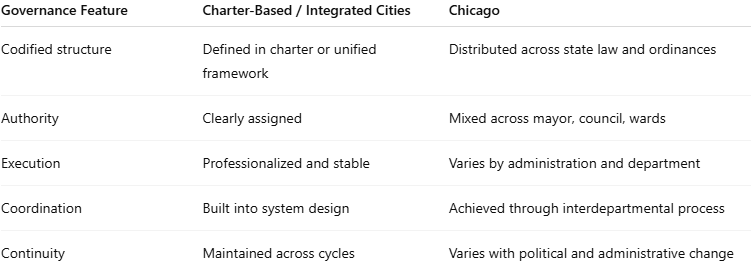
The distinction is structural rather than ideological, as cities that define their systems explicitly tend to produce more consistent outcomes, while cities that rely on distributed or evolving systems tend to produce more variable ones.
Closing
Every city operates within a structure, whether that structure has been intentionally designed or developed over time through incremental change.
Cities that perform well over extended periods tend to define their systems deliberately and update them when those systems no longer produce the outcomes they want.
Chicago has the assets of a thriving city, including strong neighborhoods, economic diversity, and a deep civic foundation.
The question is not whether those strengths exist, but whether the system is designed in a way that consistently translates those strengths into outcomes at scale.